
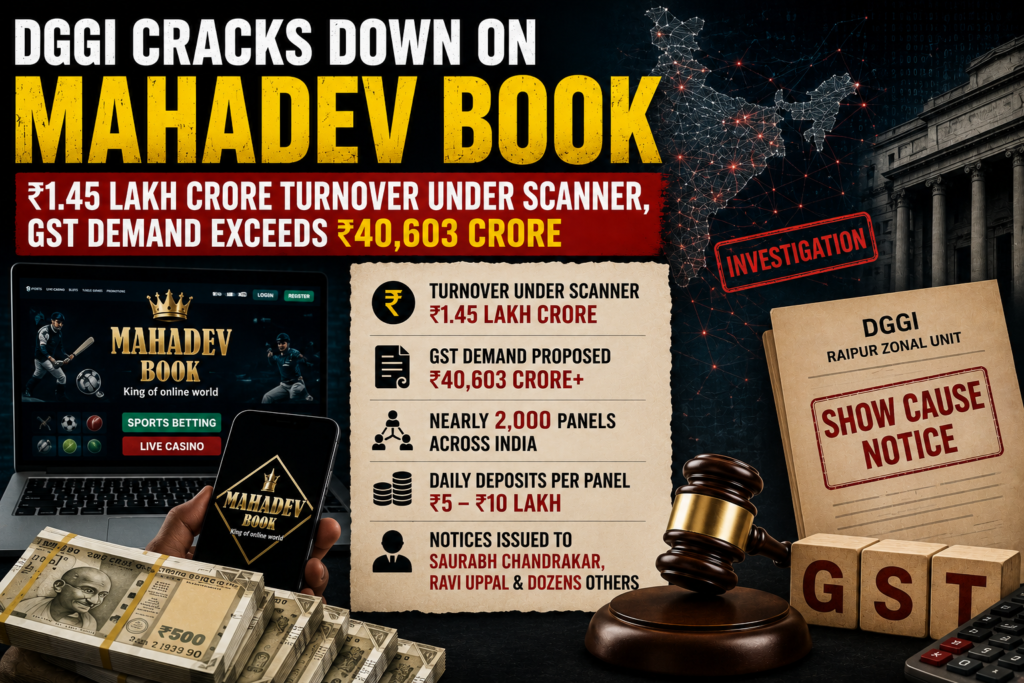

(₹5–10 lakh deposited daily through each panel; nearly 2,000-panel network under investigation; notices issued to Saurabh Chandrakar, Ravi Uppal and dozens of others)
Goa: The Directorate General of GST Intelligence (DGGI), Raipur Zonal Unit, has launched major action against the controversial Mahadev Book online betting and gaming syndicate. Following an extensive investigation led by Sujit Mallick, two major Show Cause Notices were issued on August 26, 2026, by Shivi Sangwan, Joint Director, DGGI Raipur Zonal Unit.
According to the investigation, the scale of Mahadev Book’s operations is staggering. Between April 1, 2020 and March 31, 2024, the taxable value of supplies linked to the network has been assessed at approximately ₹1.45 lakh crore, while a GST demand of more than ₹40,603 crore has been proposed.
Saurabh Chandrakar, described in the investigation as the founder and principal promoter of Mahadev Book, along with key associate Ravi Uppal and dozens of others allegedly linked to the network, have been brought within the scope of the proceedings.
What is Mahadev Book?
According to the DGGI investigation, Mahadev Book was not merely a single website or application but allegedly operated as a large online betting and money-gaming network. Various websites and online platforms were reportedly used for betting on cricket, football, tennis and other sporting events, along with other online gaming activities.
The investigation mentions platforms including gold365.com, laser247.com, play247.win, 11xplay.com, betbook247.com, silverexch.com, cricketbet9 and Skyexchange, among others.
DGGI has described Chandrakar as the principal promoter of the network, while Ravi Uppal has been identified as his key associate and co-promoter.
Nearly 2,000 Panels Across the Network
The investigation indicates that Mahadev Book allegedly operated through a vast network of betting panels. Statements recorded during the investigation reportedly showed that most panel operators said an average of ₹5 lakh to ₹10 lakh was deposited through a single panel every day.
With nearly 2,000 panels allegedly operating across the network, the daily volume of transactions was substantial. DGGI’s investigation reportedly puts the combined daily deposits across the panels at approximately ₹99 crore.
Players allegedly contacted operators through WhatsApp numbers provided on online platforms and were subsequently connected to different panels. After money was deposited into various bank accounts, players were allegedly provided betting credits or points. The investigation also reportedly uncovered the use of third-party, benami and mule bank accounts.
₹1.45 Lakh Crore Taxable Value, ₹40,603 Crore GST Demand
Based on banking transactions, the panel network, documents and statements of individuals connected with the operation, DGGI has assessed the total taxable value linked to Mahadev Book during the four-year period at ₹14,50,10,77,48,260, or approximately ₹1.45 lakh crore.
A GST demand of more than ₹40,603.02 crore has been proposed in connection with the alleged online betting operations.
This includes an IGST demand of approximately ₹35,517.22 crore for the period from April 1, 2020 to September 30, 2023, and approximately ₹5,085.80 crore for the period from October 1, 2023 to March 31, 2024.
Legal Basis Strengthened by Supreme Court’s Gameskraft Ruling
The Supreme Court’s ruling in the Gameskraft case has significant implications for GST disputes involving online gaming and betting. The judgment addressed important questions concerning GST liability and valuation in relation to online games involving money or stakes and strengthened the legal basis for departmental action in such matters.
The ruling has also become relevant to investigations involving older betting transactions and their taxable valuation. Against this legal backdrop, the DGGI investigation into Mahadev Book’s operations has resulted in the proposed ₹1.45 lakh crore taxable value and GST demand exceeding ₹40,000 crore.
No GST Registration Allegedly Obtained
According to the DGGI investigation, despite allegedly conducting online betting and gaming activities on such a large scale, Mahadev Book did not obtain GST registration, file GST returns or pay the applicable GST on the alleged business activity.
The assessment of approximately ₹1.45 lakh crore in taxable transactions indicates the potentially significant revenue impact involved in the case.
Chandrakar and Uppal Identified as Key Figures
The investigation describes Saurabh Chandrakar as the founder, owner and principal promoter of Mahadev Book. Ravi Uppal has been described as a key associate, main functionary and co-promoter, with an alleged significant role in operating the Mahadev network and managing its panel system.
The investigation also reportedly found that a substantial portion of the profits generated by the panels was allegedly transferred upwards. Statements recorded during the investigation reportedly put the Head Office’s share at approximately 70–80 per cent of the total profits.
Investigation Expands to Dozens of People
The DGGI action is not limited to Chandrakar and Uppal. The two Show Cause Notices reportedly name 66 and 31 people respectively as noticees for the two separate periods under investigation.
Those named allegedly include promoters, panel operators, key associates and individuals connected with different parts of the network. Several individuals appear in both notices because of their alleged involvement during both periods.
With approximately ₹1.45 lakh crore in taxable value, nearly 2,000 alleged betting panels, daily deposits running into crores of rupees and a proposed GST demand exceeding ₹40,000 crore, the Mahadev Book case has emerged as one of the largest GST investigations involving online betting and gaming.
DGGI Signals Wider Crackdown on Online Gaming Tax Evasion
The action is also significant as it is being viewed as a major investigation by the DGGI Raipur Zonal Unit into the online gaming sector. The case signals that the department’s enforcement efforts will not be restricted to fake invoicing and fraudulent input tax credit, but will also focus on online gaming, digital platforms and other forms of alleged tax evasion.
The department’s stated approach is that activities causing loss to government revenue will face detailed investigation and action under the law wherever evidence of large-scale tax evasion emerges.